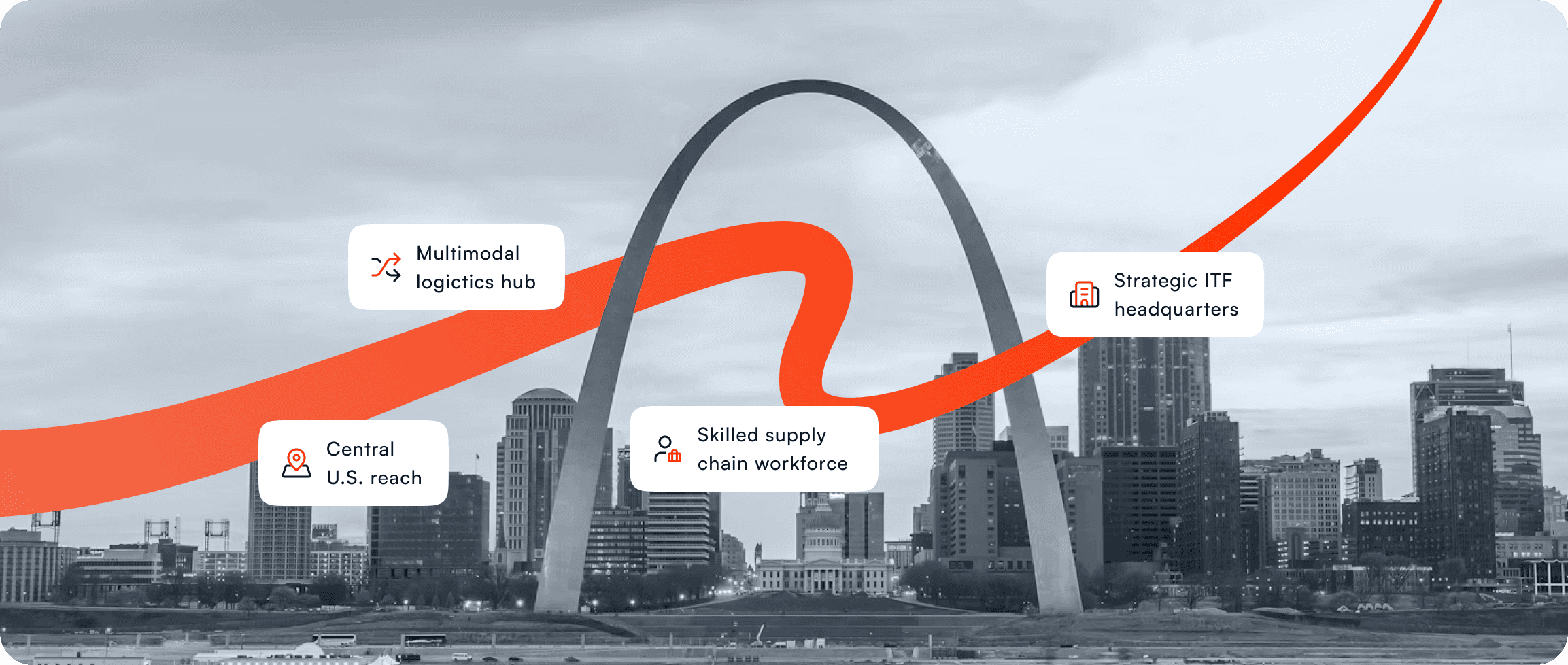
When companies design national distribution strategies, location matters. Access to major transportation corridors, multimodal infrastructure, workforce availability, and cost efficiency all play a critical role in network performance. Few U.S. cities combine these advantages as effectively as St. Louis.
As the headquarters of ITF Group, St. Louis sits at the center of one of the most strategically positioned logistics markets in the country. Its geography, infrastructure, and business environment make it a natural hub for regional and national distribution across retail, manufacturing, automotive, food, and industrial supply chains.

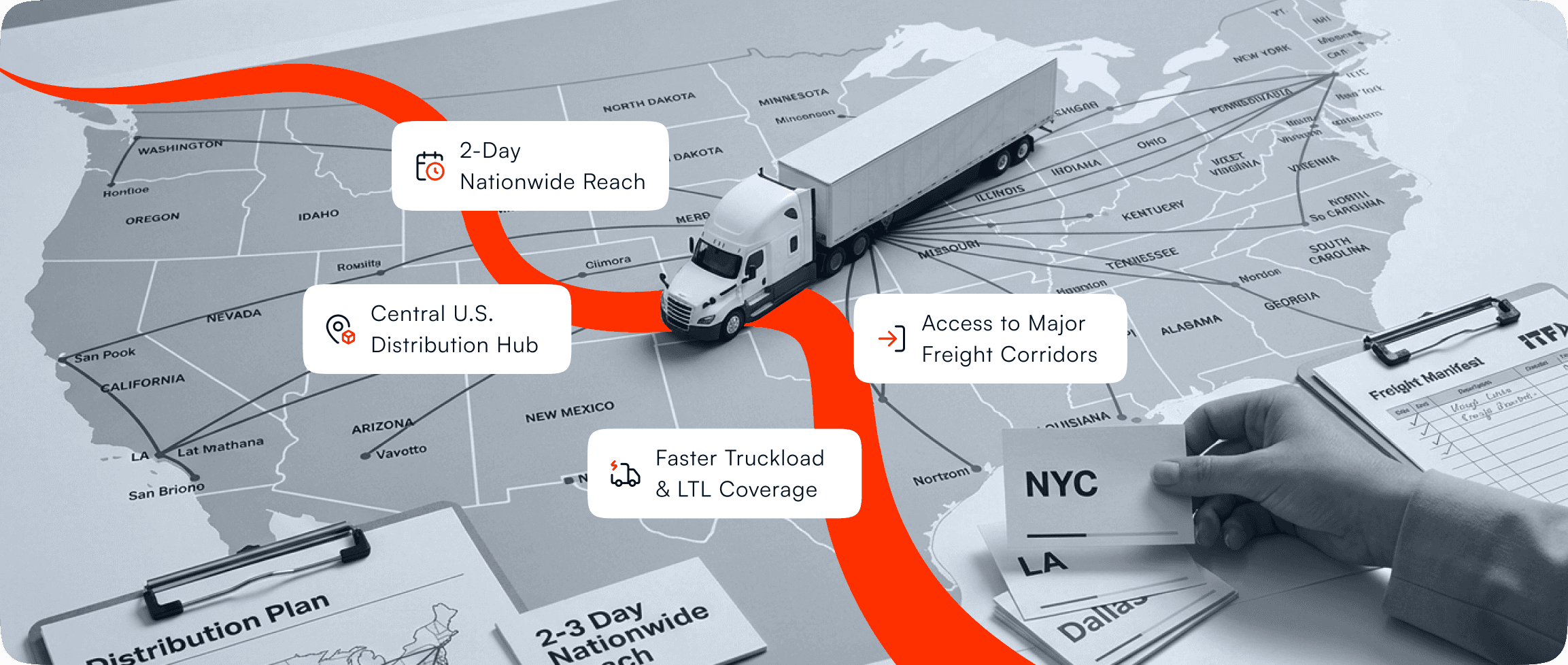
A Central Location That Reaches Most of the U.S. in Two Days
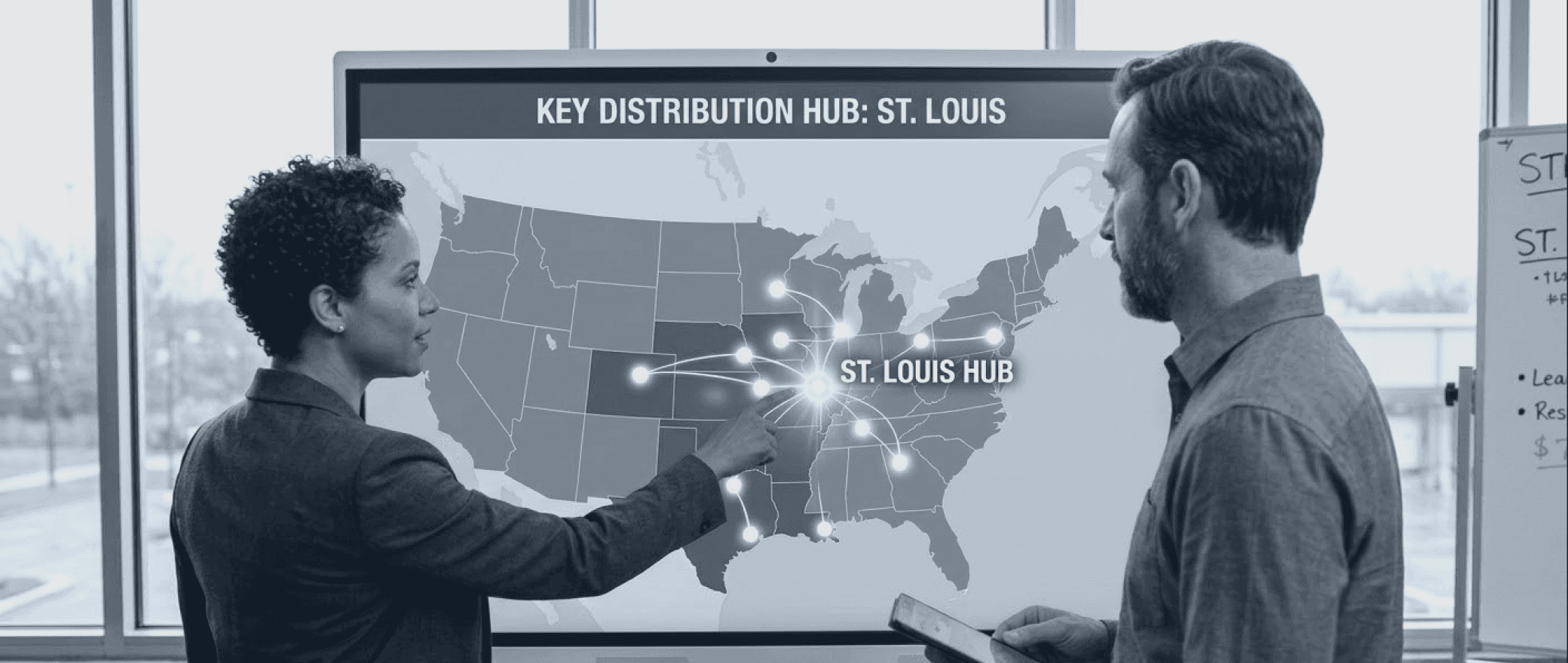
St. Louis’ geographic position places it within a two-day truck transit of a majority of the U.S. population. This central access allows shippers to balance speed and cost without overextending inventory across multiple regions.
From a single St. Louis distribution point, companies can efficiently serve the Midwest, South, and large portions of the East Coast. This reduces total transportation miles, shortens lead times, and supports consistent service levels for both B2B and B2C distribution models.

Unmatched Highway and Interstate Connectivity
St. Louis is a major crossroads for national freight movement, anchored by several critical interstate highways, including I-70, I-44, I-55, I-64, and I-270. These routes connect east-west and north-south corridors, enabling efficient freight flows across the country.
For shippers, this means fewer bottlenecks, multiple routing options, and improved resilience during disruptions. The ability to reroute freight quickly is a major advantage for time-sensitive and just-in-time supply chains.
Multimodal Strength: Truck, Rail, Air, and Inland Waterways
" height="64px" id="dFxqpG2PU" width="64px"/><path d="M 0 0 L 5.544 0 C 5.784 0 6.021 0.055 6.237 0.159 C 6.453 0.263 6.643 0.414 6.792 0.602 L 12.36 7.562 C 12.587 7.845 12.712 8.197 12.712 8.56 L 12.712 14.4 C 12.712 14.824 12.544 15.231 12.244 15.531 C 11.944 15.831 11.537 16 11.112 16 L 8.251 16" fill="transparent" height="15.999999999999996px" id="BHfrIrqbW" stroke-dasharray="" stroke-linecap="round" stroke-linejoin="round" stroke-width="2" stroke="rgb(255, 48, 0)" transform="translate(35.287 25.6)" width="12.712200000000003px"/><path d="M 19.2 22.4 L 19.2 3.2 C 19.2 2.351 18.863 1.537 18.263 0.937 C 17.663 0.337 16.849 0 16 0 L 3.2 0 C 2.351 0 1.537 0.337 0.937 0.937 C 0.337 1.537 0 2.351 0 3.2 L 0 20.8 C 0 21.224 0.169 21.631 0.469 21.931 C 0.769 22.231 1.176 22.4 1.6 22.4 L 4.8 22.4 M 4.8 22.4 C 4.8 24.167 6.233 25.6 8 25.6 C 9.767 25.6 11.2 24.167 11.2 22.4 M 4.8 22.4 C 4.8 20.633 6.233 19.2 8 19.2 C 9.767 19.2 11.2 20.633 11.2 22.4 M 20.8 22.4 L 11.2 22.4 M 20.8 22.4 C 20.8 24.167 22.233 25.6 24 25.6 C 25.767 25.6 27.2 24.167 27.2 22.4 C 27.2 20.633 25.767 19.2 24 19.2 C 22.233 19.2 20.8 20.633 20.8 22.4 Z" fill="transparent" height="25.60000076293945px" id="yNL04XnHZ" stroke-dasharray="" stroke-linecap="round" stroke-linejoin="round" stroke-width="2" stroke="rgb(0, 0, 0)" transform="translate(16 19.2)" width="27.199999237060553px"/></svg>)
Trucking
St. Louis supports a dense carrier network and strong trucking capacity, making it easier to secure reliable transportation for regional and long-haul moves.
" height="64px" id="GAtvminDa" width="64px"/><path d="M 3.2 0 L 3.2 6.24 C 3.2 7.937 3.874 9.565 5.075 10.765 C 6.275 11.966 7.903 12.64 9.6 12.64 C 11.297 12.64 12.925 11.966 14.126 10.765 C 15.326 9.565 16 7.937 16 6.24 L 16 0 M 4.8 19.04 L 3.2 17.44 M 14.4 19.04 L 16 17.44 M 3.2 25.44 L 0 30.24 M 16 25.44 L 19.2 30.24" fill="transparent" height="30.240000534057614px" id="XzIn14LyX" stroke-dasharray="" stroke-linecap="round" stroke-linejoin="round" stroke-width="2" stroke="rgb(0, 0, 0)" transform="translate(22.4 17.76)" width="19.199999999999996px"/><path d="M 0 19.2 C 0 23.68 3.52 27.2 8 27.2 L 17.6 27.2 C 22.08 27.2 25.6 23.68 25.6 19.2 L 25.6 12.8 C 25.6 9.405 24.251 6.149 21.851 3.749 C 19.45 1.349 16.195 0 12.8 0 C 9.405 0 6.149 1.349 3.749 3.749 C 1.349 6.149 0 9.405 0 12.8 Z" fill="transparent" height="27.200000000000003px" id="XZCrkzOWD" stroke-dasharray="" stroke-linecap="round" stroke-linejoin="round" stroke-width="2" stroke="rgb(255, 48, 0)" transform="translate(19.2 16)" width="25.6px"/></svg>)
Rail
As one of the nation’s largest rail hubs, St. Louis connects six Class I railroads. This rail access supports intermodal shipping, bulk movement, and cost-effective long-distance freight solutions.
" height="64px" id="Qbw0ZkLyJ" width="64px"/><path d="M 3.783 0 L 0 4.174" fill="transparent" height="4.174199999999999px" id="sEK4qUTMK" stroke-dasharray="" stroke-linecap="round" stroke-linejoin="round" stroke-width="2" stroke="rgb(255, 48, 0)" transform="translate(25.857 25.681)" width="3.783100000000001px"/><path d="M 4.037 0 L 0 4.12" fill="transparent" height="4.1205px" id="j3qSMLkdM" stroke-dasharray="" stroke-linecap="round" stroke-linejoin="round" stroke-width="2" stroke="rgb(255, 48, 0)" transform="translate(34.16 34.94)" width="4.036899999999996px"/><path d="M 23.68 26.22 L 20.8 13.1 L 26.4 7.5 C 28.8 5.1 29.6 1.9 28.8 0.3 C 27.2 -0.5 24 0.3 21.6 2.7 L 16 8.3 L 2.88 5.42 C 2.08 5.26 1.44 5.58 1.12 6.22 L 0.64 7.02 C 0.32 7.82 0.48 8.62 1.12 9.1 L 9.6 14.7 L 6.4 19.5 L 1.6 19.5 L 0 21.1 L 4.8 24.3 L 8 29.1 L 9.6 27.5 L 9.6 22.7 L 14.4 19.5 L 20 27.98 C 20.48 28.62 21.28 28.78 22.08 28.46 L 22.88 28.14 C 23.52 27.66 23.84 27.02 23.68 26.22 Z" fill="transparent" height="29.099999999999998px" id="L93_psa5U" stroke-dasharray="" stroke-linecap="round" stroke-linejoin="round" stroke-width="2" stroke="rgb(7, 17, 28)" transform="translate(17.6 17.3)" width="29.099999999999998px"/></svg>)
Air Cargo Access
With proximity to major air cargo gateways, St. Louis provides efficient options for time-sensitive and expedited shipments, supporting industries that require speed and reliability.
" height="64px" id="DApzRVM4I" width="64px"/><path d="M 0 0 L 0 6.098" fill="transparent" height="6.0976px" id="dvNqZPBQ4" stroke-dasharray="" stroke-linecap="round" stroke-linejoin="round" stroke-width="2" stroke="rgb(7, 17, 28)" transform="translate(32 29.102)" width="1px"/><path d="M 0 0 L 0 4.8" fill="transparent" height="4.800000000000001px" id="lez1uXi91" stroke-dasharray="" stroke-linecap="round" stroke-linejoin="round" stroke-width="2" stroke="rgb(7, 17, 28)" transform="translate(32 16)" width="1px"/><path d="M 22.4 12.8 L 22.4 3.2 C 22.4 2.351 22.063 1.537 21.463 0.937 C 20.863 0.337 20.049 0 19.2 0 L 3.2 0 C 2.351 0 1.537 0.337 0.937 0.937 C 0.337 1.537 0 2.351 0 3.2 L 0 12.8" fill="transparent" height="12.8px" id="UoJprTLUi" stroke-dasharray="" stroke-linecap="round" stroke-linejoin="round" stroke-width="2" stroke="rgb(7, 17, 28)" transform="translate(20.8 20.8)" width="22.400000000000002px"/><path d="M 26.21 15.698 C 27.932 12.793 28.828 9.474 28.802 6.098 L 15.702 0.276 C 15.293 0.094 14.85 0 14.402 0 C 13.955 0 13.512 0.094 13.103 0.276 L 0.002 6.098 C -0.072 10.648 1.528 15.066 4.498 18.514" fill="transparent" height="18.514000000000003px" id="SnChuCxeJ" stroke-dasharray="" stroke-linecap="round" stroke-linejoin="round" stroke-width="2" stroke="rgb(255, 48, 0)" transform="translate(17.597 29.102)" width="28.802977910769194px"/><path d="M 0 1.6 C 0.96 2.4 1.92 3.2 4 3.2 C 8 3.2 8 0 12 0 C 14.08 0 15.04 0.8 16 1.6 C 16.96 2.4 17.92 3.2 20 3.2 C 24 3.2 24 0 28 0 C 30.08 0 31.04 0.8 32 1.6" fill="transparent" height="3.200000000000003px" id="DZpynt0rs" stroke-dasharray="" stroke-linecap="round" stroke-linejoin="round" stroke-width="2" stroke="rgb(7, 17, 28)" transform="translate(16 44.8)" width="32px"/></svg>)
Inland Port and River Access
Located along the Mississippi River, St. Louis offers inland waterway access for bulk commodities and specialized freight, adding another layer of modal flexibility.

Cost Advantages Compared to Coastal Logistics Markets
Compared to coastal and major port cities, St. Louis offers significantly lower operating costs. Warehouse space, labor, utilities, and real estate expenses are typically more affordable, allowing shippers to scale operations without the premium price tags seen in coastal hubs.
These cost advantages make St. Louis especially attractive for companies seeking to optimize total landed cost while maintaining national reach.

St. Louis has a long-standing logistics and manufacturing heritage, resulting in a deep pool of experienced supply chain professionals. From warehouse operations and transportation management to engineering and analytics, the local workforce supports complex distribution requirements.
Access to skilled labor helps ensure consistent performance, faster onboarding, and operational continuity.
A Strong Manufacturing and Industrial Ecosystem
The St. Louis region is home to a diverse mix of manufacturing, automotive, food, aerospace, and industrial companies. This concentration creates supply chain synergies, supplier proximity, and a mature logistics services ecosystem.
For national distributors, operating within a strong industrial corridor simplifies inbound sourcing and outbound distribution.
Ideal for Centralized and Hybrid Distribution Models
St. Louis supports a range of distribution strategies, including:
Centralized national distribution centers
Regional Midwest fulfillment hubs
Hybrid networks combining centralized inventory with forward stocking locations
This flexibility allows companies to adapt their networks as customer demand, service expectations, and transportation markets evolve.
Why ITF Group Chose St. Louis as Its Headquarters
ITF Group’s headquarters in St. Louis reflects the region’s strategic importance in national logistics. From this central location, ITF supports transportation, warehousing, freight forwarding, and integrated logistics solutions for customers across North America.
Being headquartered in St. Louis allows ITF Group to:
Provide fast access to major freight corridors
Leverage a strong carrier and partner network
Support scalable distribution strategies for growing businesses
St. Louis Logistics Solutions with ITF Group
Whether you’re designing a national distribution network, optimizing Midwest coverage, or seeking a centrally located logistics partner, St. Louis offers a powerful advantage.
ITF Group delivers transportation, warehousing, and logistics management solutions from its St. Louis headquarters—helping shippers move freight efficiently, reliably, and cost-effectively across the U.S.
Looking to strengthen your distribution strategy?
Contact ITF Group to learn how St. Louis-based logistics can
Explore More



What Our Clients Say About Us
At ITF Group, we’ve built more than just a network; we’ve established trusted relationships with businesses across industries. Here’s what some of our valued clients have to say about their experience working with us

FAQs
Find answers to the most frequently asked questions about our services and operations. If you don’t find the answer you’re looking for, feel free to reach out to our team for more assistance.